I Bought My Mom a Coloring Book Because I Didn't Know What Else to Say
The gift that said what I couldn't. May 2026.
My father died in March. Not suddenly — a slow leaving, the kind that gives you time to prepare but no time to actually be ready. My mother sat in the front row at the funeral in a black dress she'd owned for twenty years. She didn't cry. She shook hands and thanked people and accepted casseroles in foil pans. She was so composed that people told me how strong she was, how well she was handling it.
They didn't see her at three in the morning, standing in the kitchen in her robe, staring at the coffee maker like she'd forgotten what it was for. They didn't hear the silence in her house after everyone went home — a silence so heavy it felt like another person in the room.
I live two hundred miles away. I have two kids, a job that expects me to show up, a life that keeps moving even when I want it to stop. Every Sunday I called her. Every Sunday she said she was fine. Every Sunday I hung up knowing she wasn't, and I didn't know what to do about it.
Flowers felt wrong — too temporary, too much like funerals. Food felt inadequate — she barely ate. A book seemed presumptuous; she'd stopped reading because her eyes tired after twenty pages. I wandered the aisles of a craft store one Tuesday, not knowing what I was looking for, and found myself in front of a display of coloring books.
Not children's books. These were for adults. Bold lines. Simple designs. A lighthouse on one cover, a covered bridge on another. I picked up USA Cozy Places to Go and flipped through it. The pages were thick. The lines were thick too — forgiving, patient lines that didn't demand perfection. I thought of my mother's hands, which had started to shake in the last year. I thought of her sitting in that silent house with nothing to do but remember.
I bought it. I felt ridiculous walking to the register with a coloring book for my seventy-one-year-old mother. The cashier was twenty, maybe. She smiled and said, "These are so relaxing. My grandma loves them." I almost cried in the parking lot.
My mother taught me to color inside the lines. I was five, sitting at our kitchen table in Dayton, Ohio, and she put her hand over mine to guide the crayon. "Slow," she said. "There's no rush." I remember the smell of the wax, the satisfaction of filling a space completely, the way she smiled when I held up my finished page. I had forgotten that she ever smiled like that.
The Delivery
I didn't wrap it. I drove to her house on a Saturday and left it on her kitchen table with a set of colored pencils — the soft kind, the kind that don't require pressure. I didn't include a card. I didn't know what to write.
She found it that afternoon. I was in the living room, pretending to fix a lamp that didn't need fixing, when she came in holding the book. "What's this?" she asked. Not angry. Not pleased. Just confused, the way people get when you give them something they don't know they need.
"I thought you might like it," I said, which was the truth and also a lie, because what I meant was: I don't know how to help you. I don't know how to sit with your grief. I don't know what to say. So I bought you this, and I hope it's enough.
She opened it to a page of a farmhouse with a red barn. She sat down at the table — the same table where she'd taught me to color — and picked up a blue pencil. She didn't look at me. She started coloring the sky.
It was terrible. The blue went outside the lines. Her hand shook. She stopped twice to rub her wrist. But she kept going. She colored the whole sky, and then she turned the page and colored a lighthouse, and then she turned another page and colored a covered bridge. She didn't talk to me for two hours. I sat on the couch and listened to the sound of her pencil on paper, and it was the most I'd heard from her in months.
The Change
That was twelve weeks ago. My mother has finished three coloring books. She calls me now on Wednesdays, not just Sundays, to tell me which page she's working on. She sent me a photo of her finished lighthouse — uneven, beautiful, hers — and I printed it and put it on my refrigerator.
She joined an online group for senior colorists. Seventy-three members, she told me, all sharing their pages like proud children. She bought a daylight lamp for her table. She wears reading glasses now without apologizing for them. Last week she told me, "I forgot I liked making things."
I didn't fix her grief. I didn't bring my father back. I didn't even find the right words to say. But I gave her a pencil and a page and a reason to sit at her kitchen table for an hour every morning, and somehow that was enough. Somehow that was exactly what she needed.
The Books That Made the Difference
I have bought my mother five coloring books now. I want to tell you about the ones that mattered most, in case you're standing in an aisle somewhere, not knowing what to buy for the person who has everything — or nothing — or who you don't know how to reach anymore.
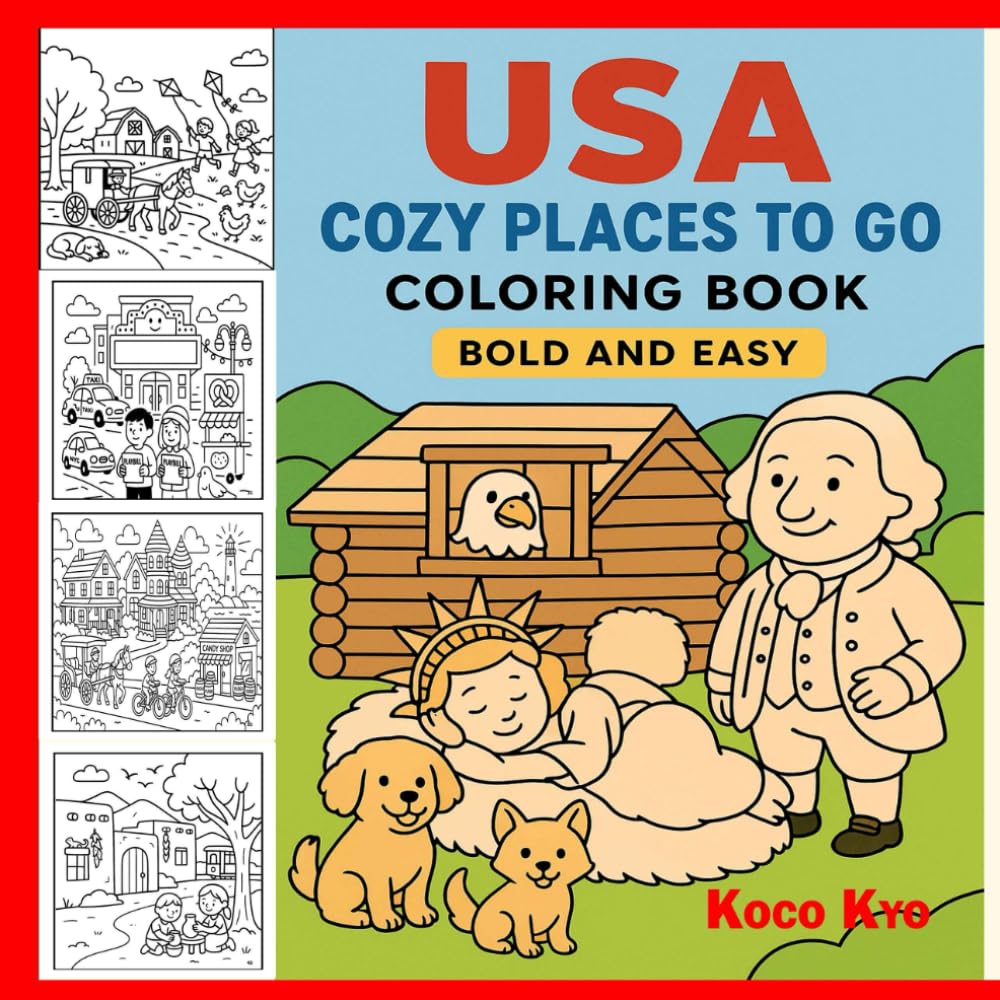
USA Cozy Places to Go
$7.99This is the book that started it all. Familiar American landmarks with bold, simple lines — lighthouses, covered bridges, main streets that look like places you've been. My mother colored the Cape Cod page and told me it reminded her of a trip she and my father took in 1987. She cried while she colored it. Then she turned the page and kept going. That's what this book does — it gives you permission to feel something, and then it gives you somewhere else to go.
View on Amazon →
Big Animal Moments
$9.99I bought this one after my mother's hands got worse. The outlines are thick and forgiving — she doesn't have to be precise, and the finished pages still look beautiful. She colored the elephant and told me it reminded her of a zoo trip we took when I was seven. The large format means she can see the lines without squinting, and the familiar animals trigger memories she thought she'd lost. For seniors with vision issues or arthritis, this book is a gift that doesn't fight back.
View on Amazon →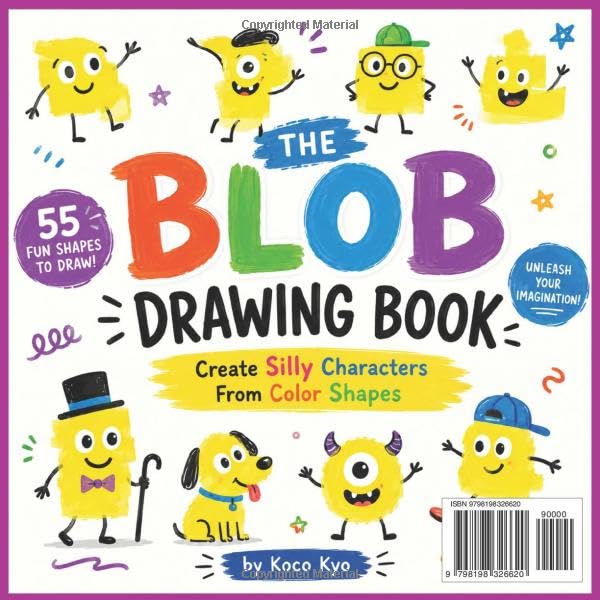
The Blob Drawing Book
$9.99On her worst days — the days when she can't stop thinking about the empty side of the bed — my mother reaches for this one. Simple shapes that become characters. No artistic talent required, no pressure to make something perfect. She told me last week, "The blob doesn't judge me." I think that's what she needed most: something that asked nothing of her except her presence. Something that let her be bad at it and still feel good about it.
View on Amazon →My mother called me at work to tell me she'd enrolled in a watercolor class. "Your father thinks it's silly," she said, but she was laughing. She painted for three years — terrible landscapes, beautiful flowers, one portrait of our dog that looked more like a raccoon. She stopped when my father's health declined. She put the easel in the garage and never took it out again. I found it last month, covered in dust, the paints dried solid. I threw them away and ordered her more colored pencils instead.
What I Learned
I thought buying a coloring book was a small thing. A placeholder gift. Something to fill the space between "I'm sorry" and "I love you." I didn't expect it to become the thing that brought my mother back to herself.
But here's what I understand now: when someone is grieving, they don't need you to fix their pain. They need you to give them a reason to keep going. A small, daily reason. Something to look forward to that isn't a memory. Something to do with their hands that isn't wringing them.
A coloring book is not a grand gesture. It is a quiet one. It says: I see you. I know you're still here. And I believe you still have things to make.
If You're Reading This Because You Don't Know What to Say Either
Maybe your parent is grieving. Maybe they're just lonely. Maybe they're getting older and you're getting scared and you don't know how to close the distance between who they were and who they are now. Maybe you, like me, have stood in a store aisle feeling helpless and small and wishing there was a gift that could say everything you can't.
There isn't. But a coloring book comes closer than you'd think.
Buy the book. Leave it on the table. Don't wrap it in fancy paper — this isn't a birthday, it's a lifeline. Include a set of soft pencils. Sit with them while they color the first page, or don't. Let them be terrible at it. Let them go outside the lines. Let them cry over a lighthouse or a barn or a blob that becomes a dog.
And when they finish their first page — however uneven, however imperfect — tell them it's beautiful. Because it is. Because they made it. Because they're still here, making things, and that is the most beautiful thing of all.
I wrote this at my kitchen table, the same table where my mother taught me to color inside the lines. Next to me is a photo she sent last week — a page from USA Cozy Places to Go, a covered bridge in Vermont, colored in shades of brown and gold that don't match anything in nature and are perfect anyway.
I don't know your story. I don't know who you're buying for, or what they've lost, or what words have failed you. But I know this: the right gift isn't about the thing itself. It's about what the thing makes possible. A coloring book makes sitting possible. It makes quiet possible. It makes "I'm still here" possible, one page at a time.
Buy the book. Say what you can. Let the rest be colored in later.
With hope,
Looking for the Right Coloring Book for Someone You Love?
These are the books that brought my mother back to herself. Maybe they'll do the same for someone you love.
Browse My Coloring Books on AmazonFrequently Asked Questions
A coloring book designed for seniors can be surprisingly meaningful. Unlike flowers that wilt or chocolates that disappear, a coloring book gives a grieving parent something to do with their hands and their time. It provides gentle structure without pressure, and finished pages offer a sense of accomplishment. Look for books with bold lines and familiar themes like USA Cozy Places to Go or Big Animal Moments.
For parents with arthritis or hand tremors, choose coloring books with thick, bold outlines and large open spaces. The Blob Drawing Book features simple shapes that require minimal precision. Big Animal Moments has thick outlines that forgive unsteady hands. Avoid intricate designs with small spaces. Pair the book with soft-core colored pencils, which glide more easily than crayons and require less pressure.
This depends on the book you choose and how you present it. Many seniors dismiss coloring as childish until they try the right book. Choose themes that match their interests — landmarks for travelers, animals for pet lovers, kitchen scenes for cooks. Leave it on the table with pencils already sharpened. The first page is the hardest; once they start, most seniors continue. My own mother said she would never color, and now she sends me photos of her finished pages every Sunday.
There is no age limit. I have heard from readers in their nineties who started coloring after receiving a book from their grandchildren. The key is choosing books designed for older adults — large print, bold lines, familiar subjects. Coloring is not about artistic skill; it is about having something peaceful to do with your hands and your attention. At any age, that has value.